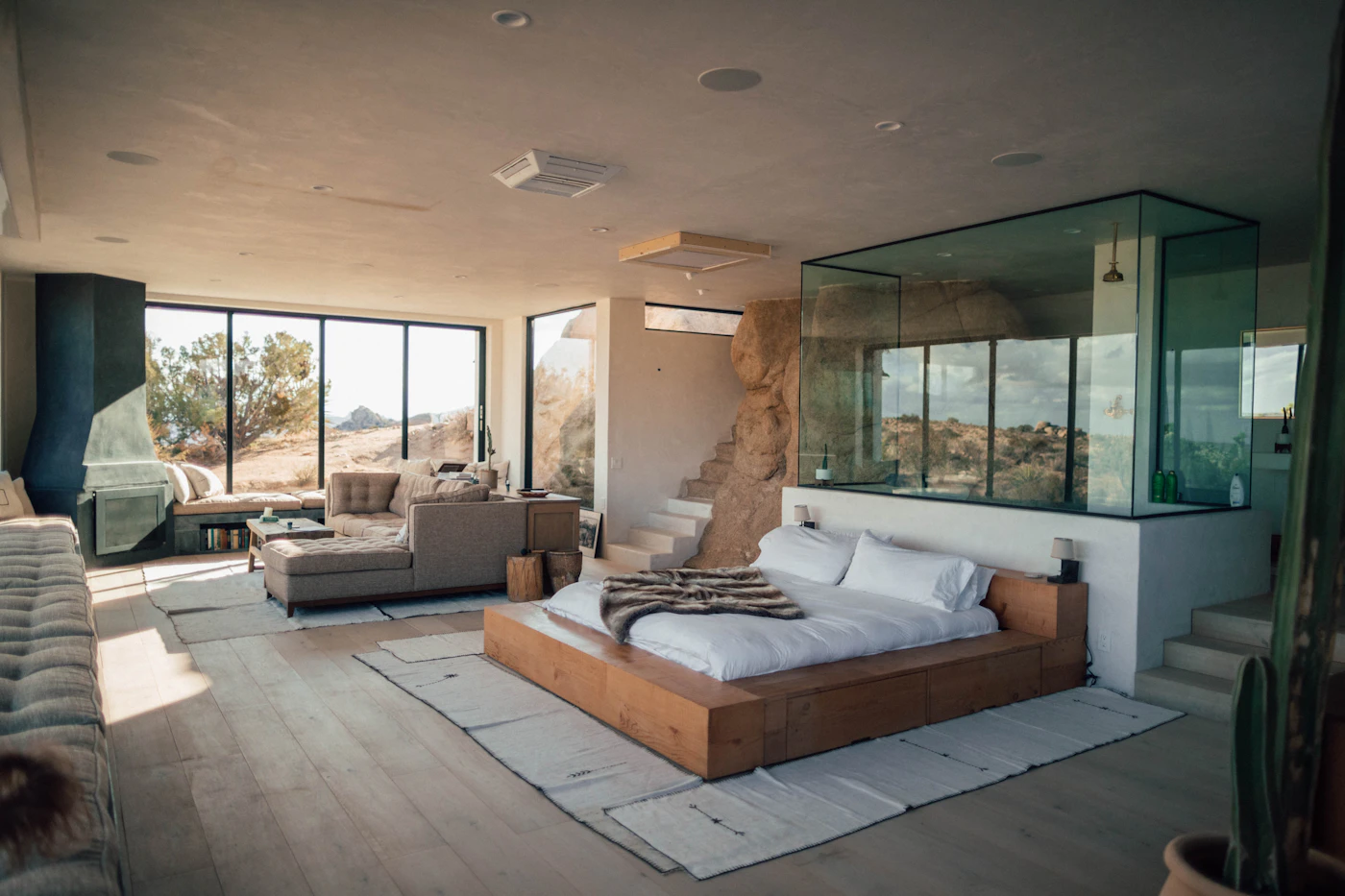
Type "family room" into any major booking platform and you'll get thousands of results. Scroll through them and you'll notice something quickly: they look almost identical. A room with beds, a bathroom, a window. Sometimes bunk beds. Sometimes a sofa bed. Occasionally a second door.
What the photos almost never show you is the thing that actually matters: whether the sleeping areas are genuinely separate. Whether there's a door between the adults and the children. Whether a five-year-old waking at 6am will wake everyone else up, or whether you might actually get a lie-in.
This guide explains the different types of family room configuration in plain language — what each one actually means, which age groups each works best for, and how to find the right one before you book.
The four types of family room
Most family hotel rooms fall into one of these four categories. Understanding which you're looking at changes everything about how useful a listing is.
Type 1 · Most common
One room, multiple beds
The most common "family room" — a single hotel room with extra sleeping capacity. Usually a double or king bed plus bunk beds or a pull-out sofa, all in the same open space. No separation between adults and children. Works for families with young children who all sleep at the same time. Less practical as children get older and bedtimes diverge.
Type 2 · Better
Alcove or partition
A room with a defined kids' sleeping area — a separate alcove, a half-wall partition, or a curtained section. The adult bed and children's beds are physically separated, but not by a full door. Sound still travels, but there's visual privacy and the children have their own defined space. Works well for children aged 4–10 who sleep reasonably soundly.
Type 3 · Best for most families
Separate bedroom with door
A suite or family room with a genuine door between the adult and children's sleeping areas. Both sides have privacy. Adults can stay up, watch television, or have a conversation without disturbing sleeping children. This is the configuration most families are actually searching for — and the one that's hardest to identify from booking platform listings alone.
Type 4 · Gold standard
Interconnecting rooms
Two fully separate hotel rooms with an internal connecting door. Each room has its own bathroom, its own television, its own entrance. The connecting door allows easy access between rooms. The most flexible option — works for any age group, gives teenagers genuine privacy, and scales well for larger families. The catch: the connection must be specifically confirmed before arrival.
Which configuration works for which age
Ages 0–4 (babies and toddlers)
- One room is usually fine — sleep schedules align
- Look for blackout curtains and travel cot space
- Ground floor rooms with enclosed outdoor area ideal
- Proximity to hotel facilities matters more than separation
Ages 5–8 (primary school)
- Separation starts to matter — bedtimes diverge
- Alcove or partition is the minimum worth seeking
- Bunk beds genuinely exciting at this age
- Door between rooms ideal but not always essential
Ages 9–12 (pre-teens)
- Separate door becomes important — they stay up later
- Want their own space, their own TV ideally
- Interconnecting rooms work very well here
- Consider whether one bathroom is enough
Ages 13+ (teenagers)
- Genuinely separate room near-essential
- Interconnecting rooms ideal — their own entrance
- Own bathroom makes a significant difference
- Two-bedroom apartment or villa often better value
What the photos won't show you
Hotel room photography is designed to make rooms look as spacious and appealing as possible. Photographers use wide-angle lenses, shoot from corners to maximise apparent depth, and choose angles that show the best features while hiding the less attractive ones.
For family rooms specifically, photos almost never show you the thing you most need to know: the relationship between the adult sleeping area and the children's sleeping area. A photo of bunk beds tells you bunk beds exist. It tells you nothing about whether there's a door between them and the double bed six feet away.
The floor plan test
If a hotel shows a floor plan for their family room — on their own website, in the booking platform listing, or in photos — that's a strong signal. It means they understand that layout matters and are confident enough in their configuration to show it transparently. Hotels that don't show floor plans often have configurations that don't hold up to scrutiny. Look for the floor plan first.
The terminology to watch for
Hotel room naming is inconsistent across the industry, but these terms appear frequently enough to be worth understanding:
"Family room" — the least informative term. Could mean anything from an extra bed in a standard room to a two-bedroom suite. Always investigate further.
"Junior suite with bunk area" — usually means a larger room with a defined sleeping area for children, often (but not always) separated from the adult area. The word "bunk" is a positive signal; "area" suggests it may not be fully separated.
"Family suite" — typically implies more separation than a "family room" — often a sitting room between two sleeping areas. Worth investigating further but a more promising starting point.
"Interconnecting rooms" or "adjoining rooms" — two separate rooms with a connecting door. The gold standard for older children. Subject to the availability caveat covered in our separate guide.
"Two-bedroom villa" or "two-bedroom apartment" — genuinely separate bedrooms within a single booking. No availability uncertainty, no connecting door question. Often the cleanest solution.
Five questions that cut through the uncertainty
Ask these before you confirm any family room booking
A one-minute phone call with these questions will tell you more than an hour of browsing photos.
- Is there a door between the adult sleeping area and the children's sleeping area?
- Can you describe the layout — where is the double bed in relation to the bunk beds?
- Do both sleeping areas have access to the balcony, garden or terrace, or just one?
- Is there a second bathroom, or do adults and children share one?
- Can you send me a floor plan or a layout photo before I confirm?
The response you get to these questions is itself informative. A hotel that answers confidently, knows their room layouts in detail, and can send a floor plan within a few minutes has thought carefully about families. A hotel that hedges, says "I'd need to check," or can't describe the layout clearly probably hasn't.
The best family hotels we've found are not always the most expensive ones. They're the ones where the room configuration has been genuinely thought through — where someone has considered what it actually means for a family of four to share a space for a week, and designed around that rather than around the maximum number of beds per square metre.